È stato recentemente pubblicato il mio nuovo articolo Genonosis: Post-natural aesthetics and regenerative systems in contemporary bioart all’interno del primo numero della rivista Biodigital Ver Sacrum – Journal of Biodigital Architecture & Design, edita dall’Institute for Biodigital Architecture & Genetics (iBAG) della Universitat Internacional de Catalunya.
Il contributo si inserisce nel dibattito contemporaneo sulle relazioni tra arte, scienza e ambiente, proponendo una riflessione sulle pratiche artistiche che operano direttamente all’interno dei processi vitali. L’attenzione è rivolta a una generazione di opere che non si limitano a rappresentare la natura, ma intervengono attivamente nei suoi equilibri, utilizzando materiali biologici, organismi viventi e tecnologie bioingegneristiche.
Al centro dell’articolo vi è il concetto di Genonosis (dal greco génesis e koinosis), un neologismo teorico che definisce un paradigma in cui l’arte si configura come sistema generativo del vivente, capace di attivare processi di trasformazione ecologica attraverso interventi bio-estetici.
In questo contesto, l’opera non è più un oggetto autonomo, ma un nodo relazionale inserito in reti simbiotiche tra esseri umani, organismi non umani e ambiente. Si tratta di un passaggio decisivo: dall’estetica della rappresentazione a una poetica dell’azione, in cui l’arte assume un ruolo attivo nei processi di rigenerazione ambientale.
L’articolo analizza tre casi emblematici di questa prospettiva: Covering Earth (2025) di Orkan Telhan, che utilizza tessuti microbici per la rigenerazione dei suoli contaminati; Korallysis (2018–2024) di Gilberto Esparza, un sistema bioelettrochimico che favorisce la crescita dei coralli; ExoGarden (2023–2024) di Anna Vershinina, un ecosistema modulare progettato per sostenere forme di vita in ambienti estremi. Questi progetti condividono una visione comune: l’arte come infrastruttura vivente, capace di attivare trasformazioni concrete nei territori e negli ecosistemi.
In un’epoca segnata da profonde trasformazioni ecologiche, il paradigma della Genonosis propone un ripensamento radicale del ruolo dell’arte: da linguaggio simbolico a pratica operativa, da oggetto a processo, da contemplazione a partecipazione. Non si tratta più di rappresentare la crisi ambientale, ma di intervenire in essa, generando nuove forme di coesistenza tra umano e non umano.
Tag: Biotechnology
L’arte digitale si mette in gioco per riaccendere la speranza
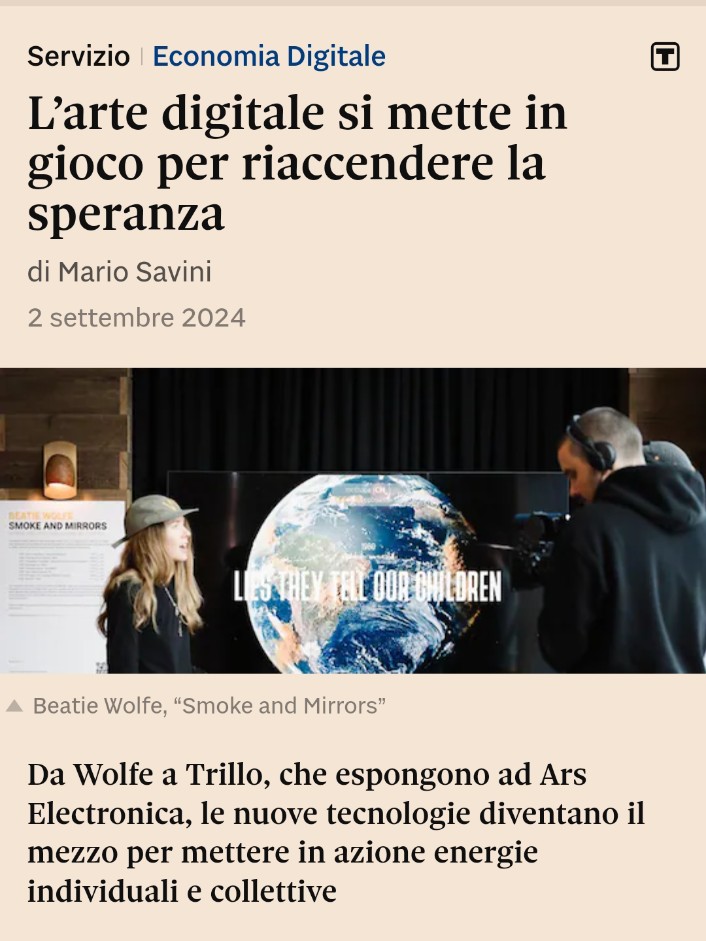
Il Sole 24 Ore – Una mia anticipazione sul festival Ars Electronica di Linz (4 – 8 settmbre 2024)
Arte e scienza per valorizzare le aree terremotate
Da alcuni mesi, ho avviato un progetto per valorizzare le aree terremotate attraverso l’uso delle biotecnologie. In questo percorso arte e scienza si fonderanno insieme.
Several months ago I started a project to support the earthquake-stricken areas through the use of biotechnology. Under this project art and science will merge together.

Transgenic Art. The new nature as aestheticization of life

Transgenic Art. The new nature as aestheticization of life. My paper is online.
The New and History art*science 2017/Leonardo 50 Proceedings.
Pier Luigi Capucci, Giorgio Cipolletta (eds.)
Transgenic art: Creativity in the era of genetic engineering

Il mio articolo “Transgenic art: Creativity in the era of genetic engineering” è ora disponibile sulla rivista scientifica “Technoetic Arts” (15.2) diretta da Roy Ascott.
My article “Transgenic art: Creativity in the era of genetic engineering” is now available in the scientific journal “Technoetic Arts” (15.2) edited by Roy Ascott.
Nòva – Il Sole 24 Ore. Il corpo nell’era digitale e biotecnologica
Nòva – Il Sole 24 Ore
Il corpo nell’era digitale e biotecnologica
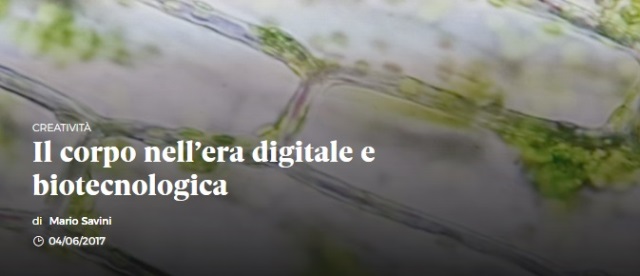
“Body Esc” propone un percorso critico sulla percezione clinica postumana di pazienti che diventano obiettivo di manipolazione come ogni altra risorsa naturale.
My abstract for the “Taboo-Transgression-Transcendence in Art and Science” Conference

Transgenic Art. Creativity in the Era of Genetic Engineering
Abstract
The spread of biotechnology and genetic engineering has developed a new creative thinking in the context of contemporary visual culture where art, science and life evolve into a network of interdependence. Starting from that, the paper analyses the works of important artists who, from the late nineties of the twentieth century, have modeled genetic material to create artistic works. These transgenic representations become a metaphor for cultural hybridisation. They are places of transaction that contradict their documentary size, losing the concept of memory, narration and storage. Artistic objects are replaced by the evanescence of aesthetics, reconsidering the relationship between image and information. This study goes beyond the boundaries of art, trying to understand the reasons of the crisis of its representation. Focusing attention on transgenic art means to say that the artist as a scientist, not only is able to change life, but to reinvent it completely. Attention is also given to mixtures of the various ontological categories where bodies are connected to machines in an intimate or hidden way, questioning the idea of nature and the concept of life. This proposal will try to answer the following questions: how has molecular biology influenced the development of contemporary art? Who is the artist today and what are the new areas of inquiry?
Nòva – Il Sole 24 Ore. Alchimisti del nostro tempo

Su Nòva – Il Sole 24 Ore il mio articolo sul Festival Ars Electronica di Linz (08.09.16 – 12.09.16). Un riflessione sugli alchimisti del nostro tempo.
In Nòva – Il Sole 24 Ore my article on Ars Electronica Festival in Linz. A reflection on the alchemists of our time.
The article in PDF: Alchimisti del nostro tempo

